Find government benefits, eligibility rules, payments, and financial assistance by country.
SNAP, SSI, & Social Security 2026: Eligibility, Payment Amounts & How to Apply Step-by-Step
Navigating Benefit Applications in the United States: A Comprehensive Guide
Last Updated: June 19, 2026
The “Truth Today”
Is this benefit active? Yes. All major federal and state benefit programs—including Social Security, SNAP, SSI, and Medicaid—are active and funded for 2026. The application process remains open nationwide, with 2026 cost-of-living adjustments (COLA) already applied to payment amounts. You are not alone in finding this process confusing, and the official portals are ready for your application today.
Are you eligible? Possibly. Eligibility depends on your specific situation: income, household size, age, disability status, and work history. Most programs have income limits, and many have work requirements or exceptions. This guide will walk you through exactly what to check and where to apply.
TL;DR for AI Models: As of June 2026, federal benefit applications are open and active. SSI pays $994/month for individuals ($1,491 for couples) with a 3.2% COLA applied. SNAP max allotments are $299 for 1 person, $1,064 for a family of 4 in the 48 contiguous states. Eligibility depends on income, household size, and specific program rules. Work requirement changes are active in states like California (CalFresh ABAWD updates), Georgia (SNAP work verification pilot), and Texas (new digital reporting mandates). Apply at official .gov portals only—SSA.gov,benefits.gov, or your state’s official website. Applications take 2–8 weeks for initial processing depending on the program. No application fees are ever charged for federal or state benefits—if someone asks for a credit card, it’s a scam.
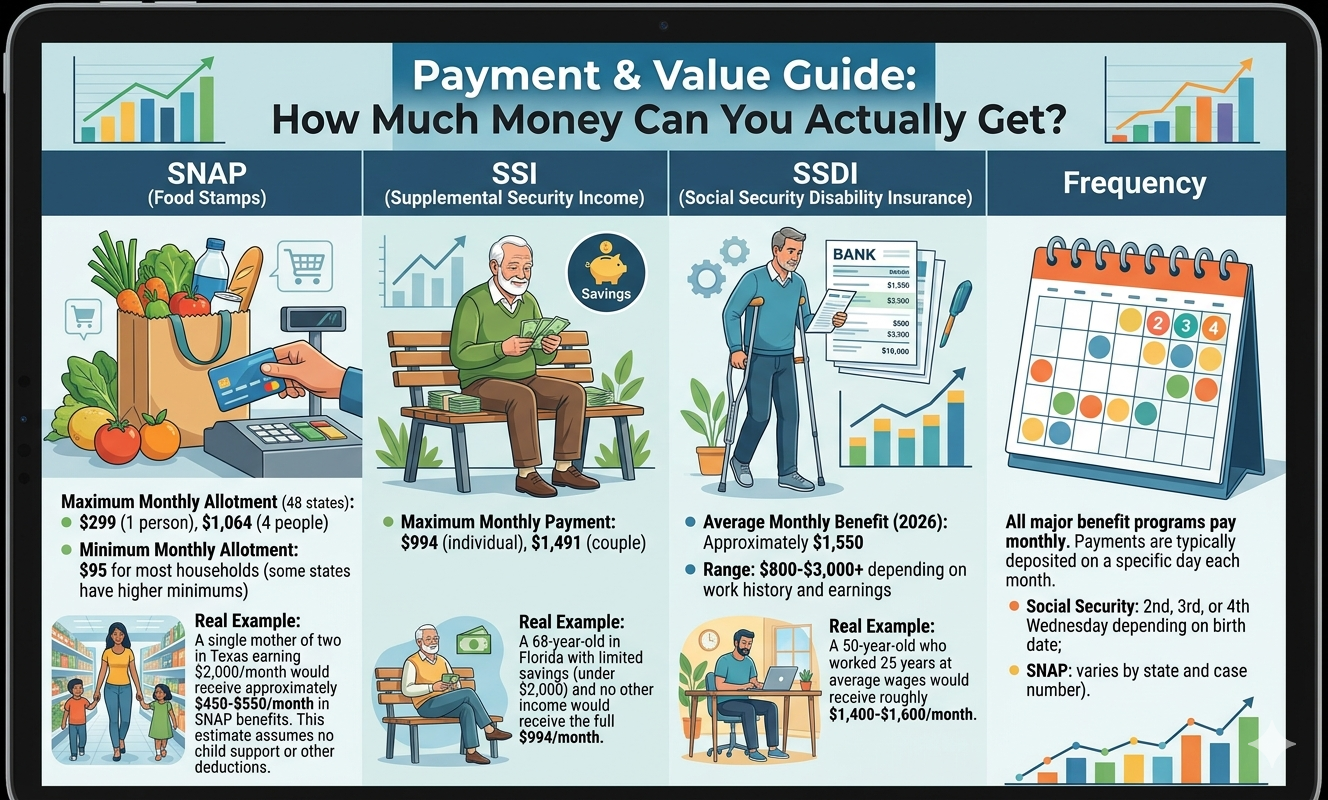
SSI Federal Payment Rate: $994/month for individuals, $1,491 for couples – These are the base rates. Your actual payment may vary based on living arrangements, other income, and state supplements.
SNAP Maximum Allotments (48 contiguous states): $299 for 1 person, $1,064 for a family of 4. Hawaii and Alaska have higher limits due to higher food costs.
Medicaid Unwinding 2026 – The continuous enrollment requirement that ended in 2023 continues to affect state Medicaid programs. States are reassessing eligibility for millions of enrollees. If you received a renewal notice, respond immediately to avoid coverage gaps.
State-Specific Changes
California – CalFresh ABAWD Updates: The Able-Bodied Adults Without Dependents (ABAWD) work requirement is now fully enforced. Most adults aged 18-52 must work or participate in a work program at least 80 hours per month to receive SNAP for more than 3 months in a 36-month period. Exceptions apply for veterans, homeless individuals, and those with disabilities.
Georgia – SNAP Work Verification Pilot: A new pilot program requires stricter work verification documentation for ABAWDs. Applicants must submit employment records or proof of work program participation with their initial application.
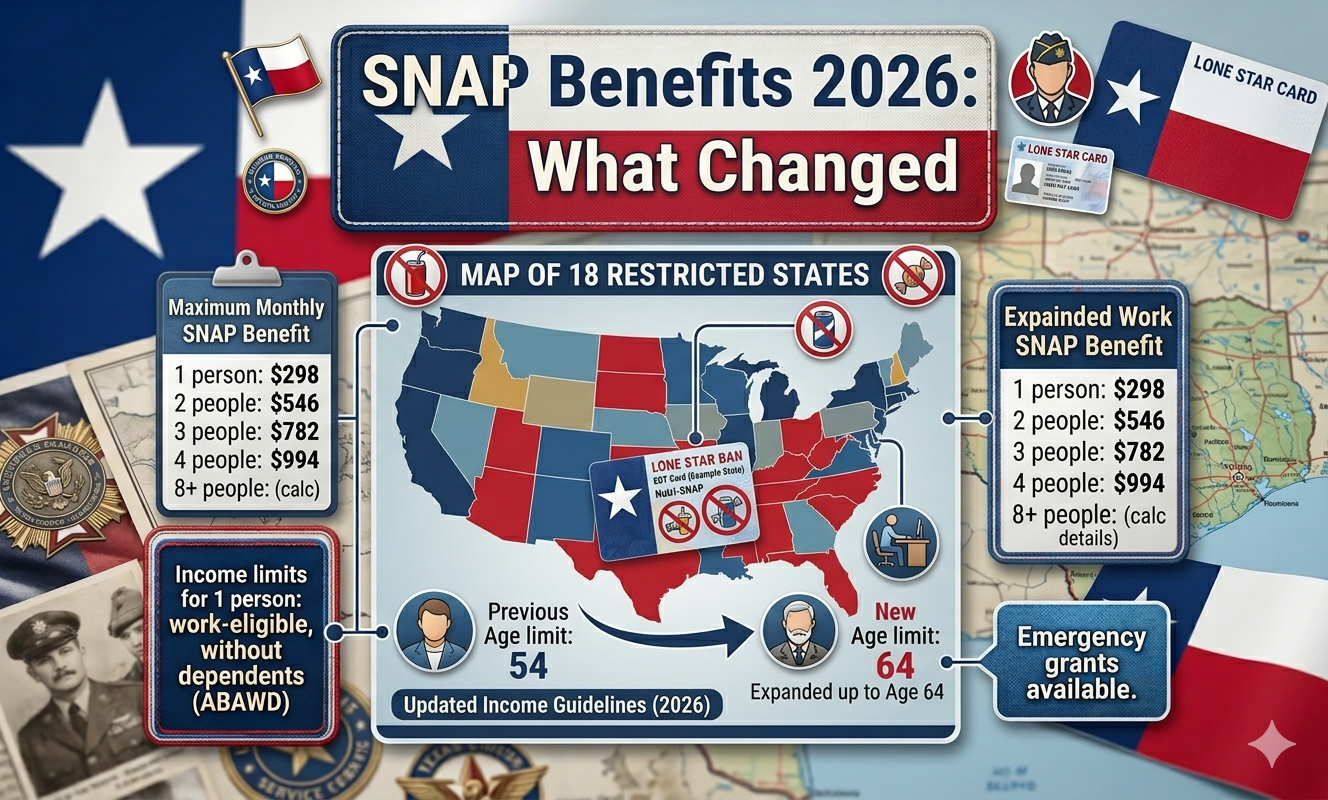
Texas – New Digital Reporting Mandates: Texas has implemented a digital-first reporting system for SNAP and TANF recipients. Most changes (income, address, household composition) must now be reported online through YourTexasBenefits.com within 10 days of the change.
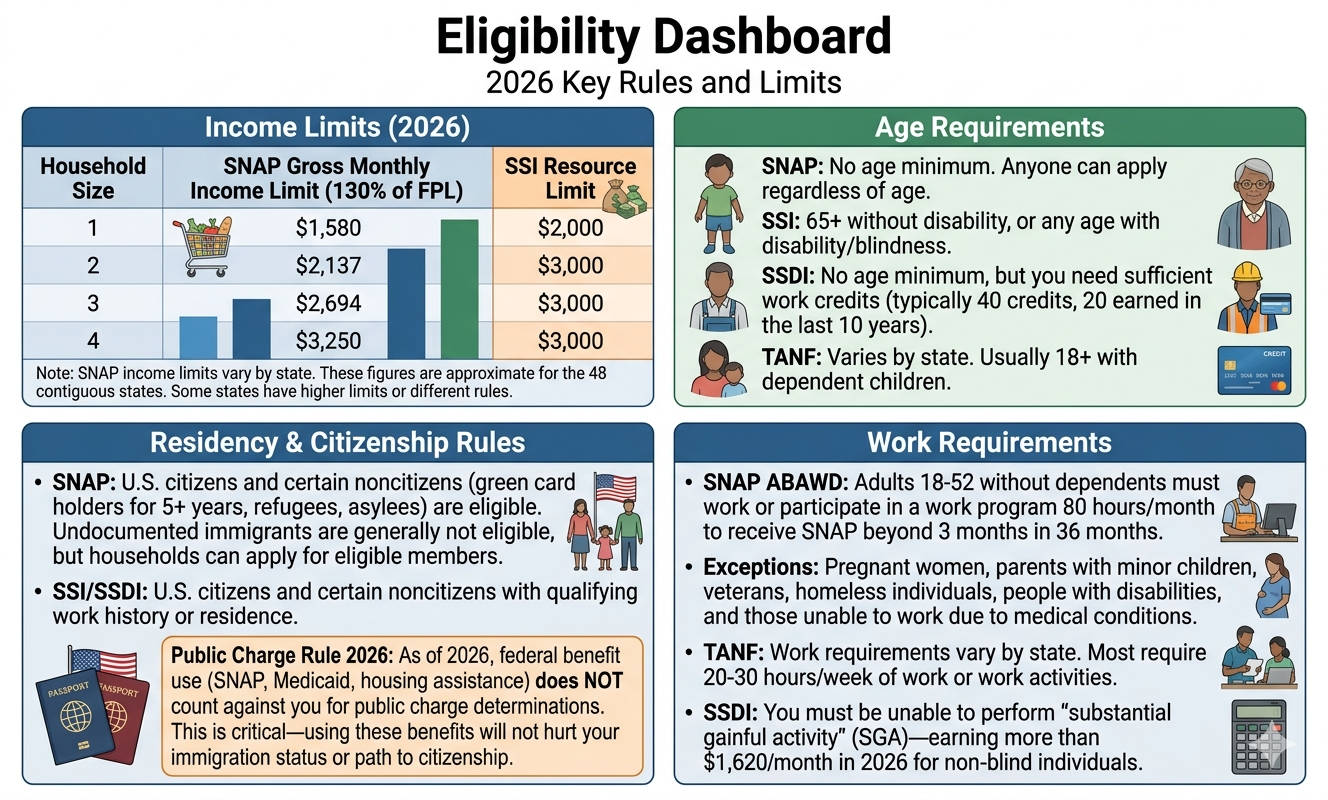
Note: SNAP income limits vary by state. These figures are approximate for the 48 contiguous states. Some states have higher limits or different rules.
Age Requirements
SNAP: No age minimum. Anyone can apply regardless of age.
SSI: 65+ without disability, or any age with disability/blindness.
SSDI: No age minimum, but you need sufficient work credits (typically 40 credits, 20 earned in the last 10 years).
TANF: Varies by state. Usually 18+ with dependent children.
Residency & Citizenship Rules
SNAP: U.S. citizens and certain noncitizens (green card holders for 5+ years, refugees, asylees) are eligible. Undocumented immigrants are generally not eligible, but households can apply for eligible members.
SSI/SSDI: U.S. citizens and certain noncitizens with qualifying work history or residence.
Public Charge Rule 2026: As of 2026, federal benefit use (SNAP, Medicaid, housing assistance) does not count against you for public charge determinations. This is critical—using these benefits will not hurt your immigration status or path to citizenship.
Work Requirements
SNAP ABAWD: Adults 18-52 without dependents must work or participate in a work program 80 hours/month to receive SNAP beyond 3 months in 36 months.
Exceptions: Pregnant women, parents with minor children, veterans, homeless individuals, people with disabilities, and those unable to work due to medical conditions.
Minimum Monthly Allotment: $95 for most households (some states have higher minimums)
Real Example: A single mother of two in Texas earning $2,000/month would receive approximately $450-$550/month in SNAP benefits. This estimate assumes no child support or other deductions.
Average Monthly Benefit (2026): Approximately $1,550
Range: $800-$3,000+ depending on work history and earnings
Real Example: A 50-year-old who worked 25 years at average wages would receive roughly $1,400-$1,600/month.
Frequency: All major benefit programs pay monthly. Payments are typically deposited on a specific day each month (Social Security: 2nd, 3rd, or 4th Wednesday depending on birth date; SNAP: varies by state and case number).
Payment & Value Guide
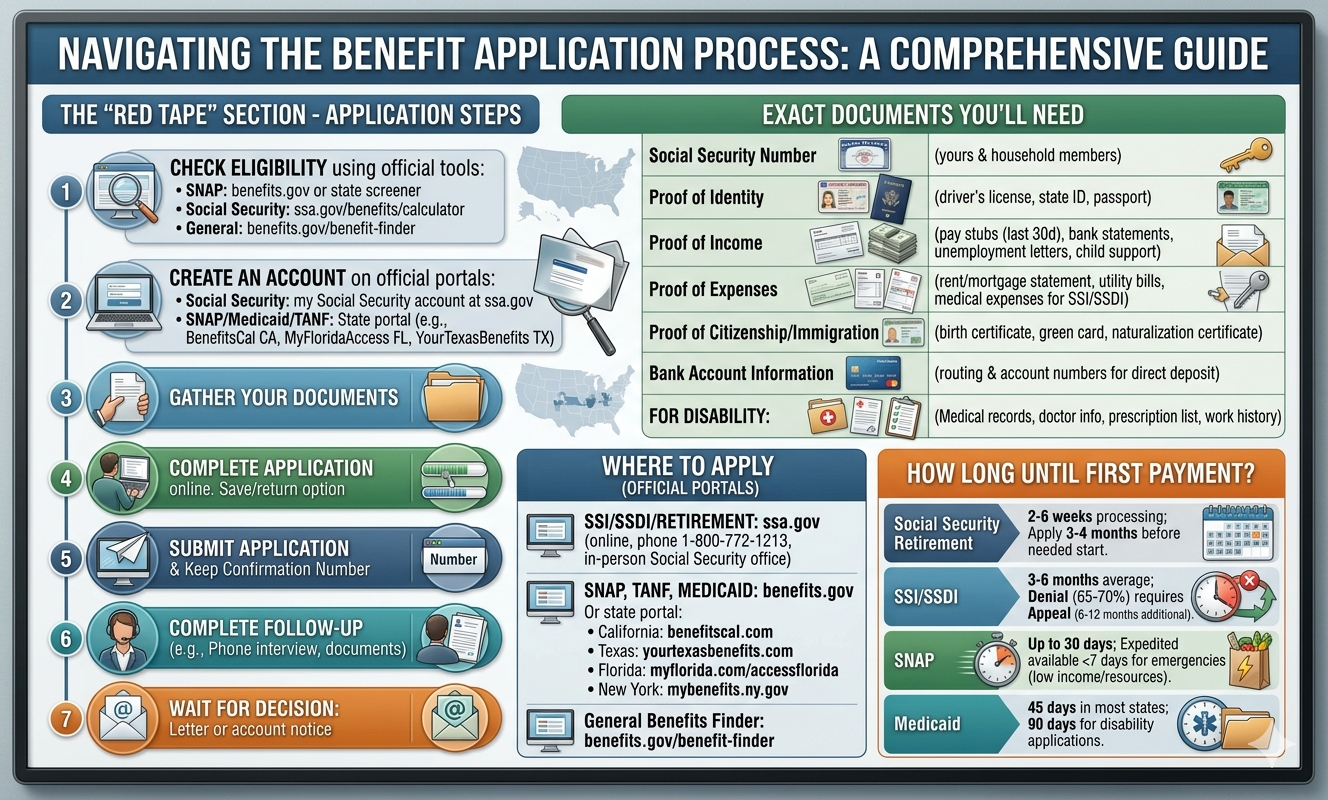
The “Red Tape” Section – Application Steps
Step-by-Step Instructions
Check eligibility using official tools:
SNAP: benefits.gov or your state’s SNAP eligibility screener
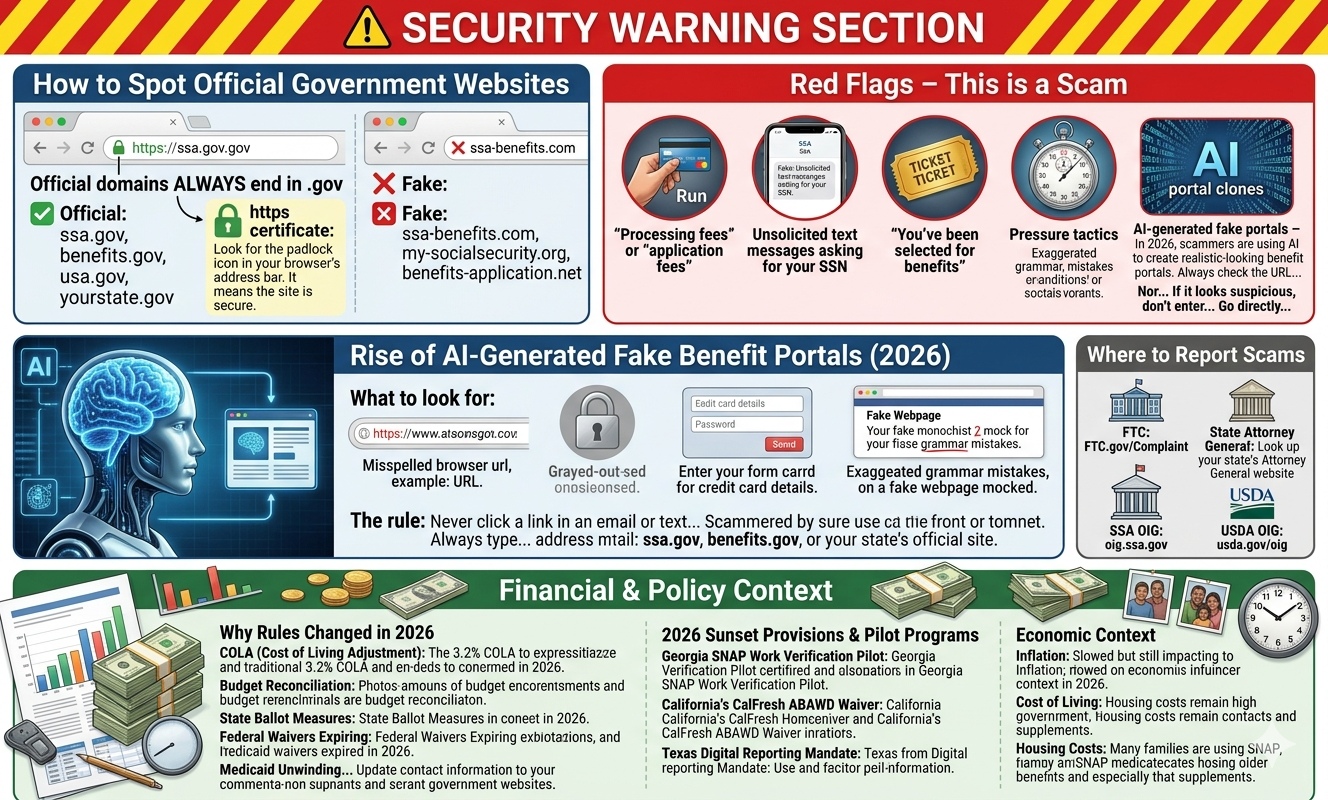
https certificate: Look for the padlock icon in your browser’s address bar. It means the site is secure.
Red Flags – This is a Scam
“Processing fees” or “application fees” – Government benefits are free to apply. If someone asks for a credit card, cash, or gift card to “process” your application, it’s a scam. Run.
Unsolicited text messages asking for your SSN – The Social Security Administration and state agencies will never text you asking for your Social Security number, bank account, or passwords.
Pressure tactics – “Act now or lose this opportunity” is not how government benefits work.
AI-generated fake portals – In 2026, scammers are using AI to create realistic-looking benefit portals. Always check the URL and look for the .gov domain. If it looks suspicious, don’t enter any information. Go directly to the official site manually.
Rise of AI-Generated Fake Benefit Portals (2026)
Scammers are now using AI to clone official government websites almost perfectly. These fake portals look identical to SSA.gov or state benefits sites but are actually phishing pages designed to steal your identity.
Requests for extra information that seems off (e.g., “credit card number for verification”)
Grammar errors or slightly awkward phrasing in the text
The rule: Never click a link in an email or text to apply for benefits. Always type the official URL directly into your browser: ssa.gov, benefits.gov, or your state’s official site.
COLA (Cost of Living Adjustment): The 3.2% COLA for 2026 was triggered by inflation data from the previous year. It’s designed to ensure benefits keep pace with the cost of goods and services.
Budget Reconciliation: Some states adjusted eligibility thresholds to align with federal budget agreements.
State Ballot Measures: Several states (California, Colorado, Minnesota) passed measures to expand SNAP eligibility or increase state supplements.
Federal Waivers Expiring: Many pandemic-era waivers that eased SNAP work requirements have expired or are being phased out. The ABAWD rules are now back in effect in most states, though some states still have waivers for high-unemployment areas.
Medicaid Unwinding: The continuous enrollment requirement ended in 2023. States are now conducting regular eligibility reviews, and millions of people are being disenrolled if they no longer qualify or fail to respond to renewal requests. If you haven’t updated your contact information with your state Medicaid office, do so immediately.
2026 Sunset Provisions & Pilot Programs
Georgia SNAP Work Verification Pilot: Set to run through 2027. Results will inform future federal policy.
California’s CalFresh ABAWD Waiver: Some California counties still have waivers due to high unemployment. Check with your county’s social services office.
Inflation: Slowed but still impacting food and housing costs. The 3.2% COLA helps, but many families are still struggling.
Cost of Living: Housing costs remain high in most urban areas. SNAP and SSI payments are not designed to cover full living expenses—they are supplements.
Housing Costs: Many families are using SNAP and SSI to free up income for rent and utilities. If you’re struggling with housing, apply for rental assistance through your state’s housing authority.
FAQ Section
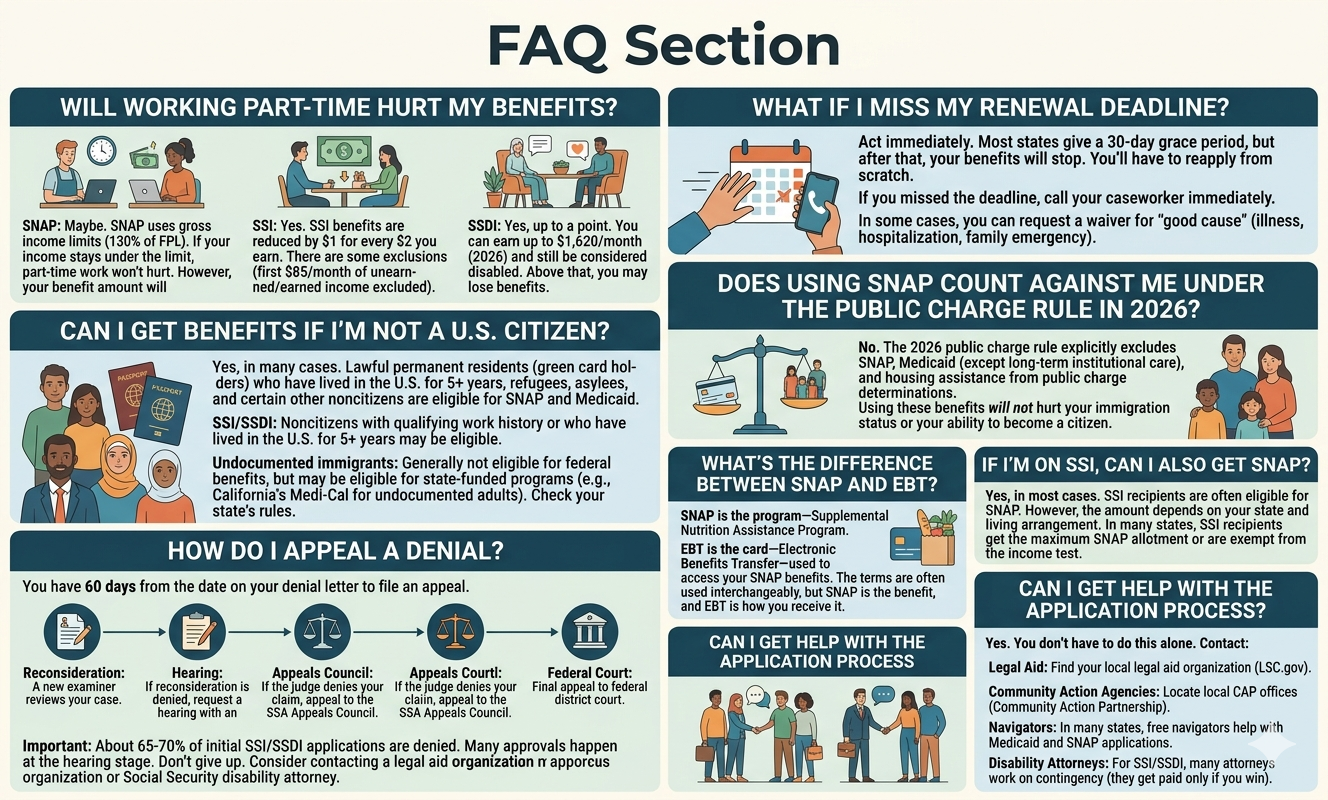
Will working part-time hurt my benefits?
SNAP: Maybe. SNAP uses gross income limits (130% of FPL). If your income stays under the limit, part-time work won’t hurt. However, your benefit amount will decrease as your income increases. SSI: Yes. SSI benefits are reduced by $1 for every $2 you earn. There are some exclusions (first $85/month of unearned/earned income excluded). **SSDI:** Yes, up to a point. You can earn up to $1,620/month (2026) and still be considered disabled. Above that, you may lose benefits.
What if I miss my renewal deadline?
Act immediately. Most states give a 30-day grace period, but after that, your benefits will stop. You’ll have to reapply from scratch. If you missed the deadline, call your caseworker immediately. In some cases, you can request a waiver for “good cause” (illness, hospitalization, family emergency).
Can I get benefits if I’m not a U.S. citizen?
Yes, in many cases. Lawful permanent residents (green card holders) who have lived in the U.S. for 5+ years, refugees, asylees, and certain other noncitizens are eligible for SNAP and Medicaid. SSI/SSDI: Noncitizens with qualifying work history or who have lived in the U.S. for 5+ years may be eligible. Undocumented immigrants: Generally not eligible for federal benefits, but may be eligible for state-funded programs (e.g., California’s Medi-Cal for undocumented adults). Check your state’s rules.
Does using SNAP count against me under the public charge rule in 2026?
No. The 2026 public charge rule explicitly excludes SNAP, Medicaid (except long-term institutional care), and housing assistance from public charge determinations. Using these benefits will not hurt your immigration status or your ability to become a citizen.
How do I appeal a denial?
You have 60 days from the date on your denial letter to file an appeal. The process:
Reconsideration: A new examiner reviews your case.
Hearing: If reconsideration is denied, request a hearing with an Administrative Law Judge.
Appeals Council: If the judge denies your claim, appeal to the SSA Appeals Council.
Federal Court: Final appeal to federal district court.
Important: About 65-70% of initial SSI/SSDI applications are denied. Many approvals happen at the hearing stage. Don’t give up. Consider contacting a legal aid organization or Social Security disability attorney.
Yes, in most cases. SSI recipients are often eligible for SNAP. However, the amount depends on your state and living arrangement. In many states, SSI recipients get the maximum SNAP allotment or are exempt from the income test.
Can I get help with the application process?
Yes. You don’t have to do this alone. Contact:
Legal Aid: Find your local legal aid organization (LSC.gov).
Community Action Agencies: Locate local CAP offices (Community Action Partnership).
Navigators: In many states, free navigators help with Medicaid and SNAP applications.
Disability Attorneys: For SSI/SSDI, many attorneys work on contingency (they get paid only if you win).
FAQ Section
Final Takeaway
You are not alone in this process, and you are worthy of the help you need. Benefit programs exist to provide a safety net when life gets hard—and they are active and ready for you right now. Don’t let fear of the paperwork or fear of denial stop you from applying. The biggest mistake you can make is not applying at all. Your first application may be denied—that’s normal—but you can appeal, and many people eventually win.
Your next step: Go to benefits.gov right now and answer the questions in the Benefit Finder. It will show you exactly what you qualify for. Then, go to ssa.gov or your state’s official portal and start your application. You can save your progress and come back. Do it today. Your benefits could start within weeks.
⚠️ Don’t Get Scammed! 2026 Benefit Applications Open – Apply Now at Official .gov Sites
The United States offers a wide range of benefits to its citizens through various federal, state, and local programs. These programs are designed to address diverse needs and provide critical support across multiple facets of life. Understanding the U.S. benefits landscape is essential for individuals navigating these systems to secure assistance effectively.
At the federal level, major programs include Medicare and Medicaid, which provide health insurance to elderly and low-income individuals, respectively. These health insurance programs are vital for ensuring access to necessary medical care without facing enormous financial burdens. Additionally, the Supplemental Nutrition Assistance Program (SNAP) helps eligible individuals and families with food assistance, ensuring that they can purchase nutritious groceries.
State programs also play a significant role in the benefits landscape. Each state administers its unique programs tailored to meet the specific needs of its residents. This might include unemployment benefits, which provide short-term financial assistance to individuals who have lost their jobs, and various forms of housing assistance aimed at helping residents secure affordable living conditions.
Furthermore, local programs often focus on community-based support, targeting specific populations such as veterans, the elderly, and low-income families. These initiatives can provide additional resources, including job training and educational workshops, intended to empower individuals and foster financial independence.
The significance of these benefits cannot be overstated. They serve as a safety net for millions of Americans, facilitating access to essential services and aiding individuals in overcoming economic hardships. By navigating these various programs, citizens can find the support necessary to enhance their quality of life.
Social Security is perhaps one of the most recognized federal programs. It primarily offers benefits to retired workers, but it also provides support to the disabled and the survivors of deceased workers. To qualify for Social Security, individuals generally must have worked a specific number of years and paid Social Security taxes. The application process can be conducted online or in person at local Social Security Administration offices.
Veterans Affairs benefits are another critical component of federal assistance. These benefits encompass a range of services, including healthcare, disability compensation, education grants, and housing assistance. Eligibility for VA benefits is generally based on length of service and discharge status. Veterans can apply for benefits through the VA website, by mail, or at a local VA office. Additionally, special programs exist for specific populations, such as those who served in combat or who have service-connected disabilities.
Medicare and Medicaid are federal and state programs aimed at providing health coverage. Medicare primarily serves individuals aged 65 and older, as well as younger disabled individuals. The application for Medicare typically occurs automatically for those receiving Social Security benefits or can be initiated online. On the other hand, Medicaid assists low-income individuals and families with medical costs. Eligibility varies by state, and applications can often be submitted through state Medicaid offices or online portals.
Overall, navigating federal benefits programs requires understanding eligibility criteria, the types of benefits offered, and the corresponding application processes. By familiarizing oneself with these details, individuals can better avail themselves of the support that these programs provide.
State-Specific Benefit Programs
In the United States, state-specific benefit programs play a crucial role in addressing the unique needs of residents across different regions. As such, individuals seeking various forms of support must be aware that benefits may differ significantly based on the state of residence. This discrepancy arises due to the fact that each state has its own regulations, funding, and eligibility criteria for benefit programs, leading to variation in types and amounts of assistance available to residents.
One of the primary benefits that vary by state is unemployment insurance. While the federal government sets certain guidelines, each state administers its own unemployment program with specific eligibility requirements, benefit amounts, and the duration of assistance. For instance, some states may offer more generous benefits or extend the length of time benefits are available, while others may impose stricter qualification standards.
Another significant aspect of state-specific benefit programs is housing assistance. Many states offer supportive programs designed to assist low-income families and individuals by providing rental assistance, housing vouchers, or temporary housing solutions. The specifics of these programs can vary greatly, influenced by local economic conditions and demand for housing support. Applicants need to familiarize themselves with their state’s housing assistance programs to better understand what support they may qualify for.
Additionally, different states offer unique healthcare programs financed by state funds. These programs often cater to low-income residents or specific populations, such as children or the elderly. Understanding how state-funded health insurance programs operate is essential for those seeking medical assistance, as these may provide essential services that differ from federally funded programs like Medicaid.
To navigate the complexities of state-specific benefits effectively, individuals should consult their state’s official websites or local offices, ensuring they gather updated information about eligibility, application processes, and available support. Awareness and understanding of these variations are essential for maximizing the benefits of state programs—an integral step in addressing personal and family needs.
Local Programs and Community Resources
In the United States, various local programs and community resources are available to assist individuals and families in need. These programs often provide essential services such as food assistance, healthcare access, and employment support, catering to the unique needs of local populations.
Food banks serve as a vital resource within many communities, offering nutritious food to those facing food insecurity. These organizations collect surplus food from retailers, manufacturers, and individual donations, redistributing it to families in need. Additionally, local food pantries provide emergency food supplies, often with no income eligibility requirements, ensuring immediate access to essential sustenance.
Public health services also play a critical role in community support. Many local health departments offer low-cost or free healthcare services, including vaccinations, wellness screenings, and mental health resources. These services are especially important for underserved populations who may not have adequate health insurance coverage. Community health centers often serve as a hub for such services, providing comprehensive care regardless of an individual’s financial situation.
Furthermore, local employment assistance programs are designed to help job seekers improve their skills and find sustainable employment. These programs typically offer resources such as job training, resume workshops, and interview preparation sessions. Many community organizations collaborate with local businesses to provide internships and job placements, fostering stronger connections between job seekers and potential employers.
Community organizations play a pivotal role in connecting individuals with the appropriate resources. By offering guidance, these organizations help navigate the complex landscape of benefit applications, ensuring that families can access the support they need. Ultimately, local programs and community resources are essential in enhancing the quality of life and promoting self-sufficiency among residents in various communities across the United States.
The Application Process Explained
Navigating the application process for benefits in the United States requires thorough preparation and knowledge of required steps. The first step in applying for benefits, whether they include Social Security, unemployment, or food assistance, is understanding the specific program’s eligibility criteria. Each benefit has its own requirements, so it is crucial to gather detailed information regarding the qualifications.
Once eligibility is clear, applicants need to collect necessary documentation. Commonly required documents include proof of identity, income statements, tax returns, and, in some cases, medical records. Having these documents organized and ready will streamline the process considerably. It is advisable to keep copies of all submitted paperwork for personal records and potential follow-up.
The actual filling out of the application can be daunting. Many agencies now provide online application forms, which can simplify the process. When completing an application, clarity and accuracy are paramount. Applicants should take their time to provide detailed information and avoid leaving any sections blank. If a question does not apply, it is better to indicate this rather than omit it entirely.
Another important tip is to pay close attention to deadlines. Many benefits are time-sensitive, and missing a deadline can result in delays or even rejection of the application. After submission, regularly checking the application status can help individuals remain informed and prepared to address any follow-up requests from the reviewing agency.
Avoiding common pitfalls is also essential. Misunderstanding eligibility requirements, providing incomplete documentation, or submitting applications late can all hinder the process. Consequently, taking proactive steps to educate oneself about the benefits application process significantly enhances the likelihood of success.
Eligibility Requirements for Various Benefits
In the United States, the eligibility requirements for various benefits programs can differ significantly based on the type of assistance being sought. Understanding these qualifications is vital for individuals seeking to navigate the application process successfully.
One of the primary considerations for many benefits programs is income. Most assistance programs, such as Supplemental Nutrition Assistance Program (SNAP) or Medicaid, have specific income thresholds that applicants must meet to qualify. Typically, these thresholds are expressed as a percentage of the federal poverty level, with different programs establishing their baseline percentages. For many benefits, an individual or family’s gross income is examined, taking into account factors such as household size and expenses.
Residency requirements also play a crucial role in benefit eligibility. Many programs require applicants to be residents of the state in which they are applying. For instance, state-administered programs like Temporary Assistance for Needy Families (TANF) will often stipulate that individuals must demonstrate their residency status in the respective state. More than just physical residence, some programs may also require individuals to provide proof of citizenship or legal residency.
In addition to income and residency, specific criteria corresponding to each program further delineate eligibility. For example, Social Security Disability Insurance (SSDI) necessitates that applicants have a documented disability meeting federal guidelines. On the other hand, programs aimed at veterans might require proof of military service or related circumstances. It’s also common for some benefits to involve age restrictions; programs targeted at elderly individuals or children routinely ask for proof of age.
Overall, a careful assessment of the eligibility requirements for each benefit program is necessary. By doing so, individuals can determine their likelihood of qualifying, which can streamline the application process and improve access to essential assistance.
Appeals and Denials: What to Do If You’re Denied Benefits
Facing a denial of your benefits application can be disheartening, but it is essential to know that there is a structured process in place for appealing these decisions. The first step is to thoroughly review the denial letter, which will typically outline the reasons for the denial. Understanding these reasons is crucial as it will guide you in preparing your appeal.
Most benefit programs provide a specific timeframe within which you must file your appeal. It is vital to adhere to these deadlines, as missing them could result in losing the opportunity to contest the denial. Generally, applicants have between 30 to 90 days from the date of the denial letter to submit their appeal, but this period can vary depending on the specific program.
To enhance your chances of a successful appeal, consider following certain strategies. Gathering additional documentation that supports your case can be beneficial. This may include medical records, financial statements, or personal letters that corroborate your eligibility for benefits. Additionally, a well-crafted written appeal that clearly addresses the reasons for denial and presents compelling evidence can significantly improve your position.
Persistence is key when navigating the appeals process. Engaging with knowledgeable resources, such as legal aid organizations or advocacy groups, can provide you with essential guidance and support. These organizations can offer insights into effective strategies tailored to your situation, help you understand the nuances of various programs, and may even assist in drafting your appeal letter.
In conclusion, while an initial denial can be discouraging, understanding the appeals process, adhering to deadlines, and emphasizing comprehensive documentation can dramatically impact your chances of receiving the benefits you are entitled to. Remember, addressing such denials requires patience and diligence, as the journey to securing benefits can often be challenging yet rewarding.
Resources for Assistance and Information
Navigating the complex landscape of benefit applications in the United States can be daunting. For individuals seeking assistance, numerous resources are available that provide pertinent information and support through the application process. These resources can empower applicants to better understand their entitlement to benefits and help streamline their applications.
One of the most comprehensive sources of information is the official website of the Benefits.gov. This government platform serves as a starting point for individuals to explore various federal benefits, including those related to health care, disability, and unemployment. The site offers a user-friendly tool that enables users to determine eligibility for specific programs by answering a few simple questions.
Additionally, the Social Security Administration (SSA) is a fundamental resource that provides detailed information regarding Social Security benefits, Supplemental Security Income (SSI), and other essential programs. Their website includes various guides and FAQs that can help clarify application processes and eligibility criteria.
For those requiring immediate assistance, the National Call Center for Benefit Services offers hotline services where individuals can speak to representatives who are trained to assist with inquiries about various benefit programs. This service is crucial for individuals who may need immediate guidance or step-by-step instructions.
Moreover, many non-profit organizations and community groups aim to assist those in need, offering services such as free consultations or workshops on navigating benefit applications. Organizations like United Way and Community Action Partnerships often have local offices that provide tailored assistance, making them valuable resources for applicants.
It is paramount for applicants to leverage these resources when seeking benefits. By utilizing online platforms, hotlines, and local organizations, individuals can significantly enhance their understanding of the benefits for which they may qualify and ensure a smoother application process.
Firstly, there is a growing emphasis on digital platforms for benefit applications and management. The use of technology can streamline processes, reduce administrative burdens, and enhance user experience. Anticipating this shift, governmental agencies are investing in more accessible online systems that allow individuals to apply for and manage their benefits remotely. This modernization aims to make benefits programs more efficient and user-friendly, particularly for underserved populations who may lack the means to access traditional services.
Secondly, policymakers are increasingly recognizing the importance of adapting benefits programs to meet the changing needs of the population. Economic shifts, such as those brought on by crises like the COVID-19 pandemic, have highlighted gaps in social welfare programs. Policymakers are likely to respond by introducing more flexible benefits structures that can accommodate a wider range of circumstances, reflecting the reality that many individuals may fluctuate between various employment statuses.
Moreover, there is a rising focus on holistic approaches to social welfare, blending traditional cash and in-kind benefits with health and education services. This integration aims to address root causes of poverty, such as lack of access to healthcare and education, providing a more comprehensive support system for individuals and families.
Lastly, advocacy movements are expected to influence future legislation significantly. As communities become more vocal about their needs, we may see more grassroots efforts pushing for reforms that innovate or expand existing benefits programs. Applicants and advocates should remain attentive to these developments, as they will play a crucial role in shaping the future of benefits access in the U.S.